Automated Price Tracking Case Study
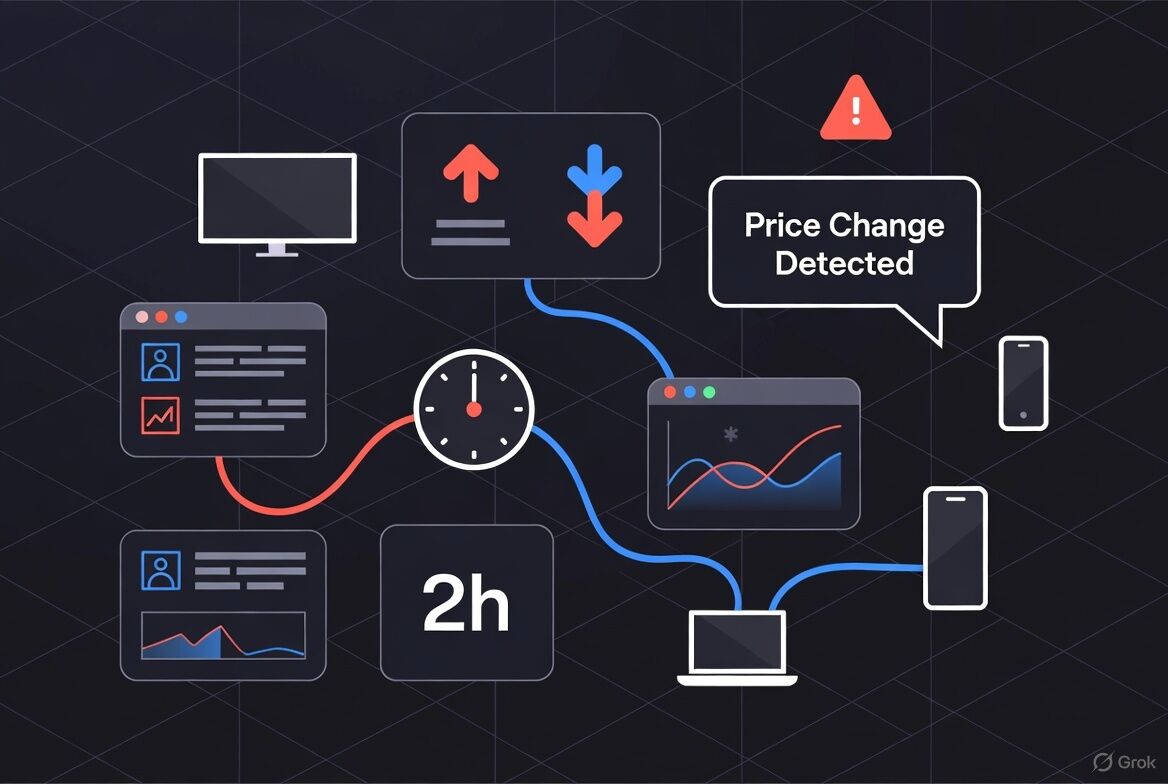
A mid-sized electronics e-commerce retailer was losing ground because their pricing team checked competitors manually - a process that took an average of 48 hours to detect a price change and respond. With hundreds of products across 5 competitors to track, they were missing up to 92% of market moves and bleeding sales to faster rivals. Let's Scrape built a custom automated price monitoring system that scrapes all 5 competitor sites approximately every hour, validates and deduplicates the data, and delivers clean CSV files to the client's S3 bucket daily - with instant email and Slack alerts the moment a relevant price or stock change is detected. A proof of concept was live within 48 hours of the initial meeting. The result: average reaction time dropped from 48 hours to ~2 hours, the team recovered 20+ hours per week previously lost to manual checks, and the client gained the confidence to act on pricing proactively - including raising prices when competitors went out of stock. The project scope was later expanded to cover two additional competitors and new data points including customer ratings.
Key Takeaways
- Reaction time cut from 48 hours to ~2 hours - competitor price changes detected and alerted within one to two hours of occurring.
- 20+ hours per week saved on manual price checks, spreadsheet updates, and repetitive review work.
- 5 competitor websites, hundreds of SKUs monitored automatically every hour around the clock.
- Proof of concept delivered in 48 hours - live data and alerts running before the client committed to full rollout.
- Up to 92% of competitor price changes were being missed under the previous manual process - a figure consistent with industry estimates for retailers relying on spreadsheets.
- Clean, structured data delivered daily to S3 - validated, deduplicated, and ready for BI dashboards with zero data wrangling by the client team.
- Alerts became early warning signals. The pricing team shifted from reactive catch-up to proactive decisions, including margin capture when competitors went out of stock.
- Strategic intelligence unlocked over time. Trend analysis revealed that one competitor consistently undercut on accessories, leading the client to renegotiate supplier pricing for that category.
- Project expanded after results. The client added two more competitors and began tracking customer ratings - a direct signal of confidence in the system.
- Compliance built in from day one. Only publicly available data, robots.txt respected, GDPR-compliant - no legal exposure for the client.
Client Challenge: Slow Manual Price Monitoring
One of our clients - a mid-sized electronics e-commerce retailer was struggling to keep up with competitors’ pricing. (For confidentiality, we won’t disclose the company’s name.) Their pricing team monitored competitor websites by hand, checking prices product by product. This manual process was painfully slow and error-prone. On average, it took about 48 hours for the client to notice a competitor’s price change and adjust their own prices. In the fast-paced electronics market, a two-day lag meant lost sales and eroding market share if a competitor dropped their price, our client might remain overpriced for days.
The client’s challenge was clear: they needed to react to price changes faster. Relying on spreadsheets and occasional checks simply wasn’t sustainable. In fact, their situation was not unique. Industry research shows that 67% of online retailers still use manual price checks, spending 11-15 hours a week on it, and missing up to 92% of competitor price changes. Our client realized they were likely missing countless price adjustments and losing revenue due to delayed responses. They needed an automated solution to monitor competitors in real time and alert them immediately when prices or product availability changed. These figures should be treated as industry estimates unless linked to a source or documented as internal client data.
Maintaining pricing competitiveness was critical. When a popular laptop model became cheaper on a rival site or a competitor ran out of stock, the client needed to know within minutes, not days.
Manual monitoring required visiting competitor websites product by product, which was too slow and too prone to human error for scale.
- 5 key competitors to monitor
- Hundreds of products to track
- 11–15 hours per week spent on manual checks
- Up to 92% of competitor price changes potentially missed
Our Solution: Automated Competitor Price Tracking & Alerts

We at Let’s Scrape knew this problem well and had the perfect solution: a custom automated price monitoring system. We worked closely with the client’s team to design a solution tailored to their needs. Here’s how we solved the challenge:
-
Custom Web Scrapers for 5 Competitor Sites: We built dedicated scrapers to navigate each of the five competitors’ websites. These scrapers were configured to find the client’s product listings (by SKU or product name) on each site and extract the current price and stock availability. We handled the nuances of each site’s HTML structure and ensured our scrapers could adapt to changes. Thanks to our robust infrastructure (10+ servers handling 650,000+ requests monthly), we ran these scrapers frequently throughout the day with high reliability.
-
Frequent Monitoring Schedule: Instead of a slow daily manual check, we set the system to check competitor prices multiple times per day. In practice, our scrapers ran on a schedule (approximately every hour) so that any price drop or increase by a competitor was caught quickly. This frequent schedule is what enabled the dramatic reduction of reaction time to about 2 hours on average often even faster.
-
Automatic Change Detection & Alerts: We implemented an alert system that would automatically notify the client whenever a significant change was detected. For example, if a competitor lowered the price of a product or if an item went out of stock on a competitor’s site, the system would immediately flag that change. We set up instant alerts via email (and an optional Slack integration) to the client’s pricing managers. This meant that within an hour or two of a competitor’s move, the relevant people at our client’s company knew about it. No more checking spreadsheets in the morning and realizing they were undercut 2 days ago now they would know almost in real time.
-
Clean Data Delivered to S3 Daily: All scraped data was aggregated, cleaned, and formatted for easy use. We applied enterprise-grade quality checks - including validation, deduplication, and completeness audits to ensure the data was accurate and trustworthy. Every day (and after each scraping cycle), the compiled pricing data was delivered as a CSV file straight to the client’s Amazon S3 bucket. The data included timestamps, competitor names, product identifiers, prices, and stock status. Because it was in CSV (structured table format), the client could easily plug it into their BI dashboards or Excel to analyze trends. This end-to-end automation (from scraping to cleaning to delivery) meant the client’s team spent zero time on data wrangling. They could focus on analysis and strategy instead of copy-pasting data.
-
Proof of Concept in 48 Hours: To build trust and ensure our solution met their needs, we developed a quick Proof of Concept (PoC) within two days. In this PoC, we set up monitoring for a handful of products on one competitor’s site and demonstrated how the alert system and data delivery would work. The client was impressed to see live data and alerts in action within 48 hours of our initial meeting. This quick turnaround proved our agility and gave the client confidence to proceed to a full-scale implementation.
-
Scalable & Compliant Implementation: Our solution was built with scalability in mind. As the client’s product range grows or if they want to add more competitors, the system can easily be extended. We also ensured full legal compliance and GDPR adherence throughout the project. We scraped only publicly available information (prices on public product pages) and respected robots.txt rules, adjusting crawling speed to avoid burdening the target sites. The client appreciated that data ethics and compliance were a priority for us it meant they could use the data without any legal worries.
Throughout the implementation, we maintained close communication with the client. We shared our experiences from similar projects and advised on best practices. For instance, we recommended the ideal frequency of checks and how to handle dynamic pricing (like flash sales or limited-time offers). We also configured the alert thresholds to match the client’s strategy e.g. alerts for any price change above a certain percentage or alerts if a competitor’s price falls below the client’s cost. Our expertise in web data extraction and pricing intelligence really shone here: we anticipated challenges like site anti-scraping measures (which we countered using rotating proxies and careful request timing) and data matching issues (we helped the client map their product catalog to each competitor’s equivalent product IDs). In short, we delivered a comprehensive, custom-tailored price tracking system that fit seamlessly into the client’s operations.
Effects and Results: Faster Decisions, Competitive Edge, Real “Wow” Impact

Automated competitor price tracking helped the retailer react in about 2 hours instead of 48, save 20+ hours per week, protect revenue, and make more consistent data-driven decisions. The system also strengthened the client’s dynamic pricing strategy by turning raw market changes into usable alerts and reports.
-
Reaction Time Slashed from 48h to ~2h: This was the headline result. Instead of waiting two days to notice competitor price changes, the client now gets notified in near real-time. On average, it takes about 1-2 hours for our system to detect a change and send an alert. In some cases, the client has been able to match a competitor’s price the same hour the competitor changed it! This agility in pricing is a game-changer. The pricing manager at the client remarked that they went from always “playing catch-up” to now being proactive and often a step ahead of competitors.
-
Significant Time Savings (20+ Hours/Week): The client’s team saved a huge amount of manual work. Previously, they had staff spending many hours collecting and updating price data by hand. With automation, we estimate they freed up over 20 hours per week that used to be spent on tedious data gathering. This is time they now reinvest in strategy, such as analyzing pricing trends, planning promotions, and negotiating better supplier deals. Essentially, our solution eliminated an entire category of busywork. One team member joked that we gave him his Mondays back, since he no longer had to start the week with a marathon price-checking session. This made the ROI of automation visible both in labor savings and in faster commercial decisions.
-
Improved Pricing Accuracy and Revenue Protection: By never missing a competitor’s price drop, the client can now adjust their prices to stay competitive on core products. This has had a direct impact on sales and margins. For example, in the first month after implementation, the client identified and matched dozens of significant price cuts by competitors that they might have missed before. They noticed fewer instances of being undercut in the market. While exact revenue figures are confidential, the client reported that this proactive pricing approach helped them avoid revenue loss that would have occurred had they kept prices too high for days. In some cases, they even spotted opportunities to increase prices when a competitor went out of stock (capturing extra margin while still remaining the only seller). The net effect was a healthier bottom line and more confident pricing decisions.
-
Customized Alerts and Better Decision-Making: The automatic alerts for price and availability changes became an integral part of the client’s daily routine. Every morning, the team reviews a summary of any overnight changes. If a competitor’s price drops sharply or if a product becomes unavailable elsewhere, the relevant sales manager can react instantly (for instance, by running a promotional match or highlighting that product’s availability in marketing). The client described these alerts as “early warning signals” that give them peace of mind. They no longer worry that something important happened in the market without them knowing. This confidence is invaluable it shifts their mindset from reactive to proactive.
-
Data-Driven Strategy and Competitive Advantage: Having a reliable feed of competitor pricing data has unlocked new strategic insights. The client can now analyze pricing trends over time - for example, seeing if a competitor tends to discount certain gadgets on weekends or if another competitor is testing dynamic pricing on popular items. With our delivered CSV data integrated into their BI tools, the client created a dashboard to visualize price movements across competitors. This insight helped them identify patterns, such as one rival who was consistently 5% cheaper on accessories (leading our client to negotiate better supplier prices for those products). In short, our solution provided not just faster reaction times, but also a broader view of the competitive landscape, giving the client a true competitive edge. In practice, this supported a stronger dynamic pricing strategy grounded in data-driven decisions rather than delayed manual checks.
The business outcomes were very positive. Our client could respond to market changes in hours instead of days, which in the world of e-commerce meant capturing sales that would have otherwise been lost. They also reported improved customer satisfaction by ensuring their prices were never grossly higher than competitors, customers gained trust that the client’s store always offers a fair deal. Internally, the project champion at the client company earned praise for modernizing their processes. It’s not an exaggeration to say this automation transformed their pricing operations. What used to be a pain point is now a strength.
Perhaps one of the best indicators of success: the client decided to expand the project after seeing the results. They asked us to add two additional competitor websites to the monitoring list and to begin tracking new data points such as competitors’ customer ratings and review counts (to correlate price changes with product popularity). The fact that they wanted to broaden the scope of the project shows the level of trust and value they found in our collaboration. We were, of course, happy to oblige and continue supporting their needs.
Final Thoughts

This case study demonstrates how a professional web scraping and data automation solution can solve the exact problem that many retailers face: staying on top of competitor prices. Our client went from manual, slow, and incomplete price monitoring to an automated, real-time system that empowered them to make faster and smarter decisions. The result was a measurable improvement in efficiency and competitiveness a true win-win for the client’s team and their business performance. For retailers operating in fast-moving categories, that kind of automation creates a repeatable framework for better pricing governance and more confident execution.
At Let’s Scrape, we pride ourselves on delivering these kinds of results. We combine technical expertise with a deep understanding of business needs to create solutions that make a real difference. And we always maintain our clients’ confidentiality and trust as you noticed, we haven’t revealed the client’s name or sensitive details, because we respect privacy and NDAs while sharing the essence of the success story. The same approach can support broader reporting, benchmarking, and ongoing optimization as the client grows.
FAQ:
- What is automated price tracking?
Automated price tracking uses web scraping to monitor competitor prices in real time, collect structured data, and deliver alerts so businesses can react to market changes in hours instead of days. - How fast can automated price monitoring detect competitor changes?
In this case, competitor price changes were checked roughly every hour, which reduced reaction time from around 48 hours to about 2 hours on average. - How much time can automated price monitoring save?
The retailer saved more than 20 hours per week that had previously been spent on manual checks, spreadsheet updates, and repetitive review work. - What is the difference between manual and automated price monitoring?
Manual monitoring covers only a fraction of products and depends on human effort. Automated monitoring tracks large SKU sets across multiple competitors continuously and sends alerts automatically. - How quickly can a price monitoring system be set up?
A proof of concept can be delivered within 48 hours, while a fuller production setup depends on the number of competitors, products, alerts, and delivery requirements.